


FOB vs CIF vs DDP is the comparison you should make on every China quote, because the three letters change who pays freight, who holds risk, and how much of the shipment you actually control. This is a practical glossary, not legal advice. Use it to read a factory or forwarder quote. For the door-to-door work we run, see shipping from China.
What Incoterms decide on a China quote
Incoterms decide who pays for freight and insurance, where risk passes from seller to buyer, and which tasks sit on which side of the China port.
They do not replace a contract. They do not set your import duty rate. They do not include inspection. They only allocate transport jobs and risk points. If a quote is silent on the term, ask. A cheap unit price on EXW is not comparable to a DDP number.
You will also see EXW (you pick up at the factory) and sometimes CFR. EXW dumps export work on you. FOB is the cleaner starting point for most first-time importers who still want control of the ocean leg.
The term must match the price. If the factory quotes FOB Ningbo and you later ask for DDP to your warehouse, that is a different job with different costs.
Download Incoterms 2020 PDF cheat sheet
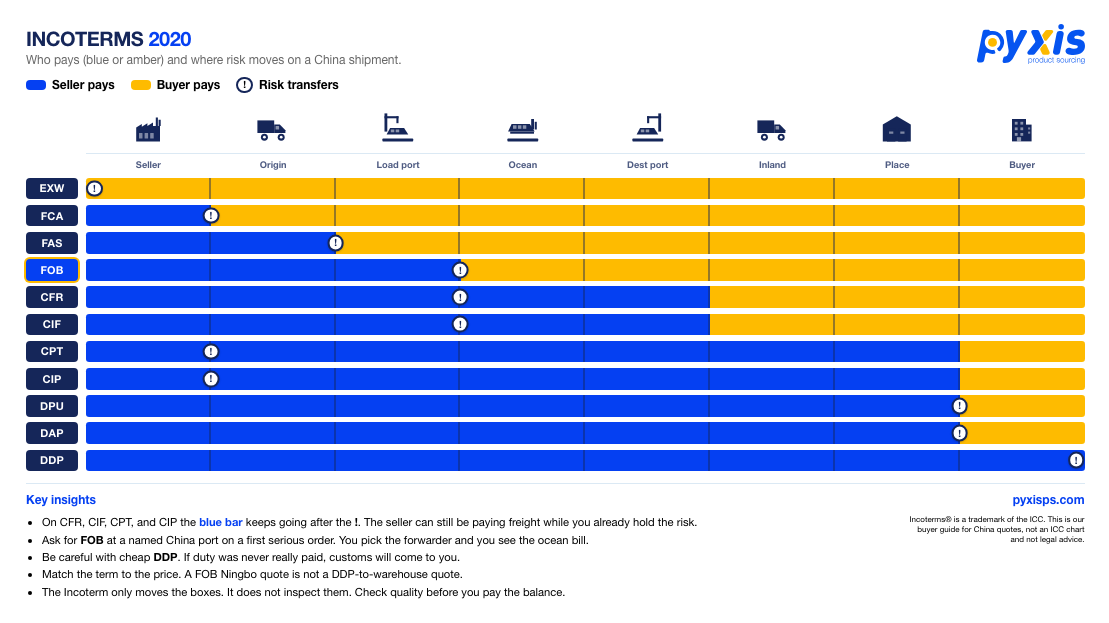
Print this Incoterms chart and keep it next to your China quotes. Blue is what the seller pays. Amber is what you pay. The exclamation mark is where risk moves. The free PDF covers EXW, FCA, FAS, FOB, CFR, CIF, CPT, CIP, DPU, DAP, and DDP.
FOB: you control freight after the port
FOB means the seller delivers the goods on board at the named China port. You (or your forwarder) book the ocean freight, insurance, and the destination side.
Who pays. The factory covers getting goods to the vessel at that port, including typical export clearance on their side when the quote is a real FOB factory quote. You pay ocean freight, insurance if you buy it, destination charges, duty, and last-mile.
Who holds risk. Risk typically passes once the goods are on board at the named port. After that, delay and damage in transit are your problem to manage with the carrier and insurance.
When it fits. FOB gives more control. You pick the forwarder. You see the freight bill. You are less likely to discover that "cheap shipping" was a surprise destination invoice. For a first serious order, FOB is the term we usually want on the table.
Short scenario: you buy 200 cartons FOB Shanghai. We inspect, the factory loads, your forwarder books the vessel. You know the ocean rate before the ship leaves.
CIF: the seller books ocean freight
CIF means the seller pays ocean freight and minimum insurance to a named destination port. You still handle import clearance, duty, and delivery after the port.
Who pays. The seller's price includes cost, insurance, and freight to that port. You still pay destination fees, customs, and trucking. Those destination fees are where "cheap CIF" often hides.
Who holds risk. On CIF, risk still tends to pass at the origin vessel, even though the seller booked the freight. People miss this. Paying freight is not the same as holding the risk.
When it fits. CIF can be convenient if you do not want to book origin freight. It is weaker when you want to compare real ocean rates or when the seller's "friend forwarder" is opaque. Ask what is included at destination. Ask which port. Ask what insurance actually covers.
Short scenario: a factory quotes CIF Los Angeles at a nice number. At the port you meet terminal fees, customs broker fees, and a truck. The landed cost is no longer the CIF number. Run that math the same way we do in landed cost and order quantity.
DDP: door delivery can hide duty problems
DDP means the seller delivers to your named place and is supposed to cover duty and import clearance. Cheap DDP can hide underpaid duty, slow clearance, or a broker you do not control.
Who pays. On paper, the seller pays almost everything to your door. In practice, some "DDP" offers skip proper duty, use a route that stalls, or add destination charges later. If duty was never really paid, you own the problem when customs asks.
Who holds risk. DDP puts more delivery obligation on the seller. That sounds safer. It is only safer if the seller actually clears customs correctly in your country. A low DDP price on a high-duty product is suspicious.
When it fits. DDP can work for small parcels or when you have a seller with a proven door-to-door record in your market. It is a poor way to ignore shipping on a first container of a new SKU.
Short scenario: a listing offers DDP to your warehouse for less than FOB plus a normal freight quote. That gap has to come from somewhere: thinner packing, a worse carrier, or duty that is not really settled.
Which term to ask for on a first order
Ask for FOB on a first serious order so you control freight and see the real ocean cost. Treat cheap DDP with caution. Use CIF only when the destination charges are written down.
A simple preference order for most of our buyers:
- FOB at a named China port, with your forwarder
- CIF only if origin booking is a hassle and destination fees are itemized
- DDP only if you trust the door-to-door process and the duty treatment
- Avoid EXW unless someone in China is already handling pickup and export
Pair the term with inspection. FOB does not inspect the goods. Neither does DDP. The Incoterm moves the boxes. Quality is a separate gate before you pay the balance.
Hidden freight, the wrong mode (air vs sea), and missing export docs are the usual shipping pains. The term you pick should make those costs visible, not bury them.
Next steps
If you want help choosing a term and booking the China side, contact us or see pricing. For sea, air, and export docs, read shipping from China. For how freight and duty move with volume, see landed cost and order quantity.

