

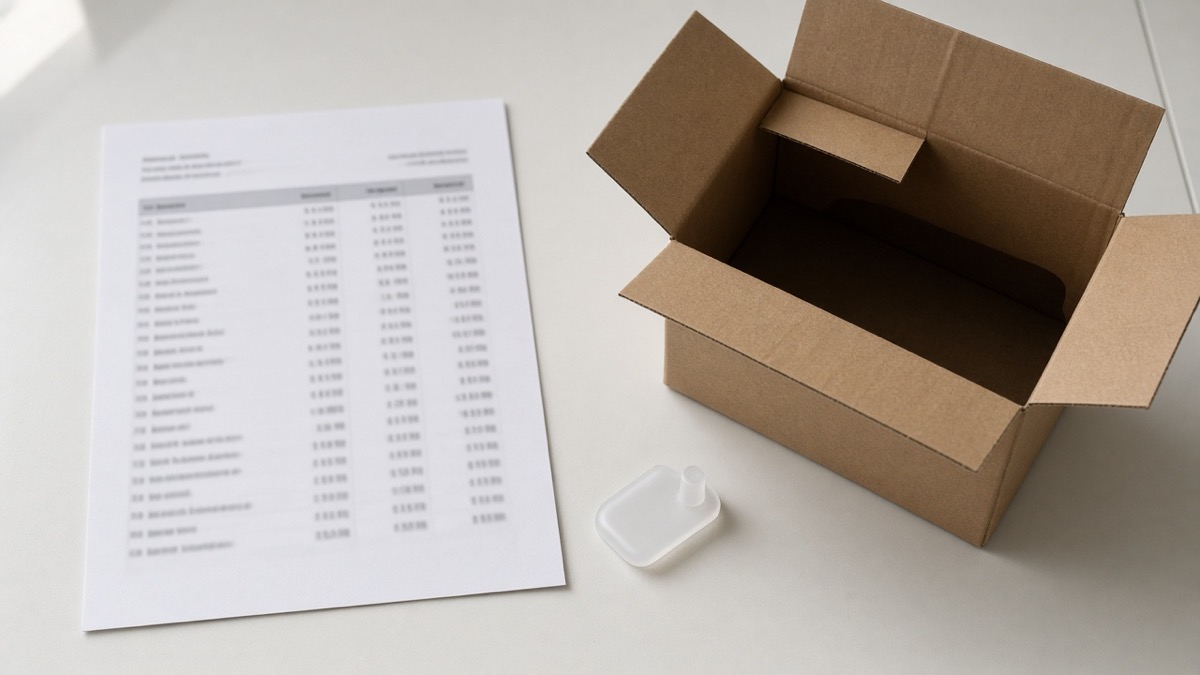
Our clients sometimes send us a quote and ask why the number we gave them looks higher. Most of the time the difference is Incoterms, or hidden costs that some sellers keep secret until the buyer is ready to pay. Hidden costs when sourcing from China are the lines the unit price sometimes leaves out. The mold, the packaging, the truck to the port (domestic shipment), and a lab test can all be missing from that number. We don't keep any costs hidden. Before you decide, we tell you exactly how much you will pay, and what each amount is for. No surprises.
Split the quote before you compare it
A quotation you get in chat is not enough for the final decision. That number is the price of one unit, and most of the time it leaves out the other costs of sourcing the product. It leaves out the mold, the carton, and domestic shipping, usually to the port. Ask about every expense in detail. Add them up, then divide by the quantity. That is the real price per unit. Only after that can you compare suppliers. Incoterms, domestic shipping, tooling, and packaging all go into that unit cost. We do this daily when we compare quotations from manufacturers.
Tooling is its own bill
If you are buying a standard product, you should not worry about tooling. The manufacturer already has the machines and tools to make it. If you are sourcing a custom-made product, calculate the mold and tooling separately. A logo or a color change can still need a small tool, and the manufacturer will charge for that separately. The logo tooling cost is not large, especially on a big order. Some factories fold the tool into the unit price. This is bad for you. When the tooling cost is hidden, you cannot compare the unit price with other manufacturers. We ask for the mold fee as its own line before production starts. The mold price depends on the cavity, the steel, and the part. If the design is yours, the contract should say who owns the tool when the order ends. You don't want the factory selling your custom-designed product to someone else. When we make custom products for clients, we put this in the contract we sign with the manufacturer. Our company is based in China, so we have an easier legal route if there is a dispute. One more thing: the tooling cost can change after the manufacturer starts work on your design. At the start they always give an approximate tooling cost. When you are ready to place the order, renegotiate. For custom-made products, see OEM vs ODM vs private label.
Packing is part of the product
"Standard packing" means a completely different thing on different products. Always ask what the standard package is. It can be an OPP bag, a zip bag, plastic packaging, ABS packaging, a carton, several products in one color box, one product in one color box, and many more. Each option has its own price. Know the packaging price on its own, so you can change it later if you need to. Outer cartons matter just as much. Depending on your shipping method, you may need larger cartons, smaller cartons, or wooden cartons. Some warehouses set a weight limit per carton (Amazon FBA, for example), or they require a barcode. Discuss those rules with the manufacturer. Honestly, not every manufacturer knows which packaging option is best for you. You either know the rules yourself, or you need somebody in China to handle the details (me!).
An EXW price and an FOB price are different jobs
EXW means you take the goods at the factory door. You still pay the truck to the port and the export booking. FOB usually carries the goods to the vessel at the named port. Add the truck and the export booking to the EXW number before you treat it as cheaper than FOB. If you already work with a freight forwarder, ask the seller to recalculate the FOB price to your carrier's location. You can compare prices only after domestic shipping is in the total. For a large order we usually ask for an FOB price to the closest port. If the order is small and we consolidate several orders in one place, we ask for EXW, then calculate domestic shipping separately and add it up, so you know what you are paying. This matters on consolidated orders because each manufacturer can be in a different part of China. The Incoterm breakdown is in FOB vs CIF vs DDP. Ocean freight per unit and duty also move with quantity. As a rule of thumb, the more you buy, the less you pay in duty and shipping per unit. If you want to know why, I wrote about it in landed cost and order quantity.
Sample shipping and lab tests
Depending on the product, a manufacturer can send a free sample. Domestic shipping in China is cheap, so the factory usually covers it. The sample shipping is free. If the sample needs to be shipped to your country, you pay for that. Ask them to confirm that in writing. If the product is regulated, there are tests as well. Sometimes the manufacturer will not pay for the test. That is another cost the unit price leaves out.
Product sourcing has a lot of details. From the outside it looks simple, but someone has to organize the steps so the order stays on track. If you don't have time for that and you want to focus on your business at home, we can handle the China side. On our percent fee, inspections are part of the job. On the Flat Rate Sourcing Fee, travel, accommodation, and the product sample (depending on the product) are extra. International freight and customs in your country sit outside both fees. The ranges are in what a China sourcing agent costs.
Conclusion
Add tooling, packing, domestic shipping, the Incoterm, and any lab test to the factory number. Divide by the quantity. Then compare suppliers.
Next steps
If you want those lines split before you pay a deposit, contact us or see pricing. For freight and duty, read landed cost and order quantity. For who pays the move to the port, read FOB vs CIF vs DDP.