


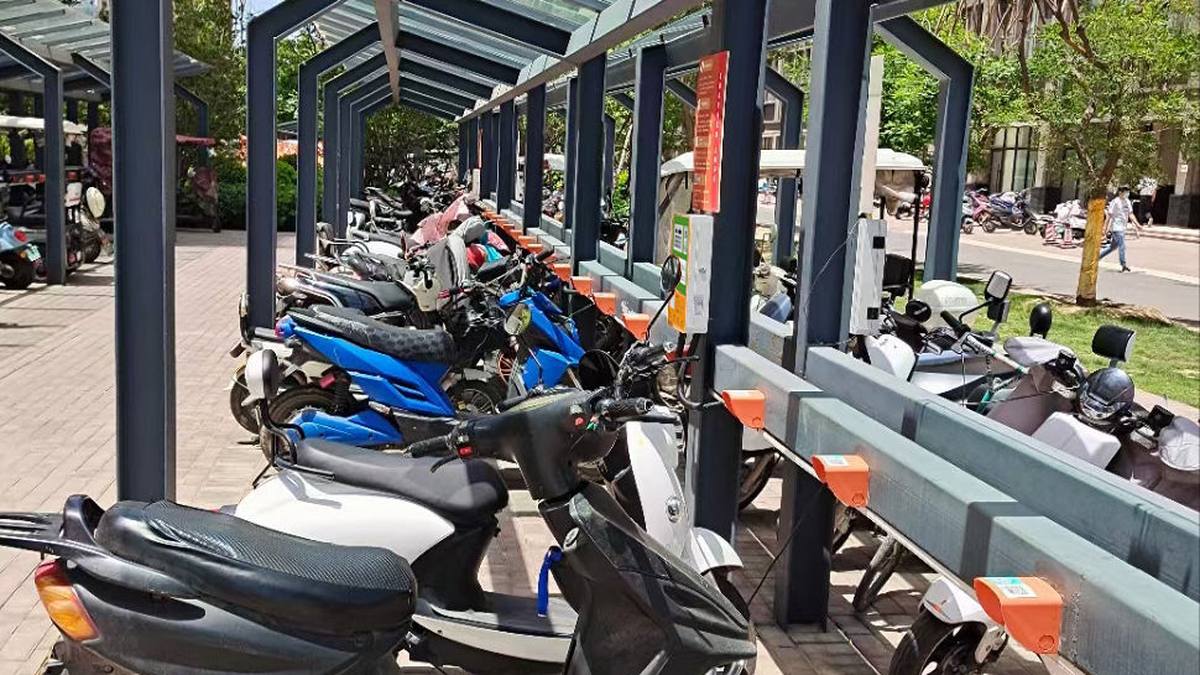
Across China, landlords, convenience store operators, and apartment complex managers are quietly collecting money every hour of the day. Not from rent or product sales, but from electric bikes and motorcycles charging in their parking lots. They did not build an app or hire staff. They plugged in a cabinet, connected it to the internet, and set their price. This post explains how the system works, what the numbers look like, and how importers can source e-bike charging cabinets from China for their own markets.
From 1995 to 350 Million Bikes
China's electric bicycle industry traces back to around 1995, when the first commercially available models appeared. They were slow, ran on heavy lead-acid batteries, and had limited range, but the price was right. For tens of millions of delivery workers, commuters, and small business owners, they solved a real problem.
By the early 2000s, cities like Wuxi, Tianjin, and Changzhou had become manufacturing hubs. Then government policy accelerated everything. Motorcycle bans in dozens of major cities, introduced to cut emissions and congestion, pushed riders toward electric two-wheelers, which were classified differently, often required no license, and produced zero direct emissions.
By 2010, China was producing over 20 million units per year. By 2022, annual production passed 50 million, with a total fleet estimated at more than 350 million electric bikes and motorcycles, more than the population of the United States. Brands like Yadea, Aima, NIU, and Luyuan became household names.
As the fleet grew, a new problem emerged: where do all these bikes charge? Early on, riders carried batteries indoors to charge from wall sockets. But battery fires from substandard chargers became a real issue, and fire safety rules pushed regulators and property managers toward dedicated outdoor charging infrastructure. That is where the charging cabinet business was born.
The Hardware
A standard charging cabinet is a weatherproof outdoor unit, wall-mounted or freestanding, with anywhere from 6 to 20 individual charging ports. Each port supplies AC power to a connected bike or detachable battery at a controlled wattage. Inside, there is a control board, a 4G or Wi-Fi module for internet connectivity, and a display or indicator panel for users.
Battery swap cabinets go a step further. Instead of plugging in and waiting, a rider walks up, unlocks a slot, swaps a depleted battery for a fully charged one, and rides away in under 60 seconds. NIO popularized the swap concept for cars, but in the two-wheeler space it has been mainstream in China for years.
Payments and the Cloud
Every cabinet connects to a cloud-based management platform. The owner logs into a backend dashboard, a web portal or mobile app, and sees every port, every active session, and every transaction in real time.
In China, payment runs almost entirely through Alipay and WeChat Pay. A user scans a QR code on the cabinet, selects a port, and the fee is deducted automatically when the session ends. No cash, no card readers, no friction.
For export markets, the payment module is a configurable layer on top of the hardware. Manufacturers can integrate Stripe, PayPal, M-Pesa, or local bank transfer systems depending on the target country. And for markets where digital payment infrastructure is still developing, the units support RFID prepaid cards: the operator issues cards, users top them up and tap to charge, and balances and rates are controlled from the backend. No smartphone required on the user side.
The Unit Economics
The math is straightforward. Take these assumptions:
- Local electricity cost: $0.10 per kWh
- A typical e-bike battery: 0.8 to 1 kWh, so roughly $0.08 to $0.10 per full charge
- Operator price: around $0.30 to $0.40 per kWh, a markup of roughly 200 to 300 percent
- A 20-port cabinet at 60% utilization: about 80 to 100 charging sessions per day
At a margin of $0.15 to $0.30 per session, one cabinet generates $12 to $30 per day, with minimal ongoing effort after setup. In dense urban zones, that scales quickly across multiple units.
Critically, the operator can change pricing at any time from the dashboard. If electricity costs rise, prices adjust. If demand spikes in the area, the price follows. The operator stays in full control.
Sourcing from China
This is exactly what we do at Pyxis Product Sourcing. We are based in China and work directly with the factories that build these cabinets and battery swap stations, not middlemen or trading companies.
The process starts with a sourcing assessment of your target market, volume requirements, and budget. We then identify and vet multiple suppliers, provide comparative quotes, and handle all communication in Chinese so nothing gets lost in translation. We work with manufacturers who have export experience, which means CE certification for European markets, UKCA marking, and guidance on local compliance depending on where you deploy.
On payments, we coordinate directly with the manufacturer's software team so your local payment method works from day one, whether that is Stripe for Europe, M-Pesa for East Africa, or a local bank's API. For markets with limited payment infrastructure, we specifically source units with robust RFID card support.
Why Now
The electric two-wheeler market is not slowing down. Europe, Southeast Asia, Latin America, and Africa are all seeing rapid adoption, and charging infrastructure is not keeping pace. China has already solved the hard problems: the hardware works, the software is proven, and the business model is validated at massive scale.
If you are exploring this for your own market, reach out. Tell us your market, requirements, and budget range, and we will come back with concrete supplier options and pricing.
Next Steps
Exploring e-bike charging cabinets for your market? Tell us your requirements and we will return supplier options. See also pricing for research packages and solar garden flower lights for another China product category we source.

