


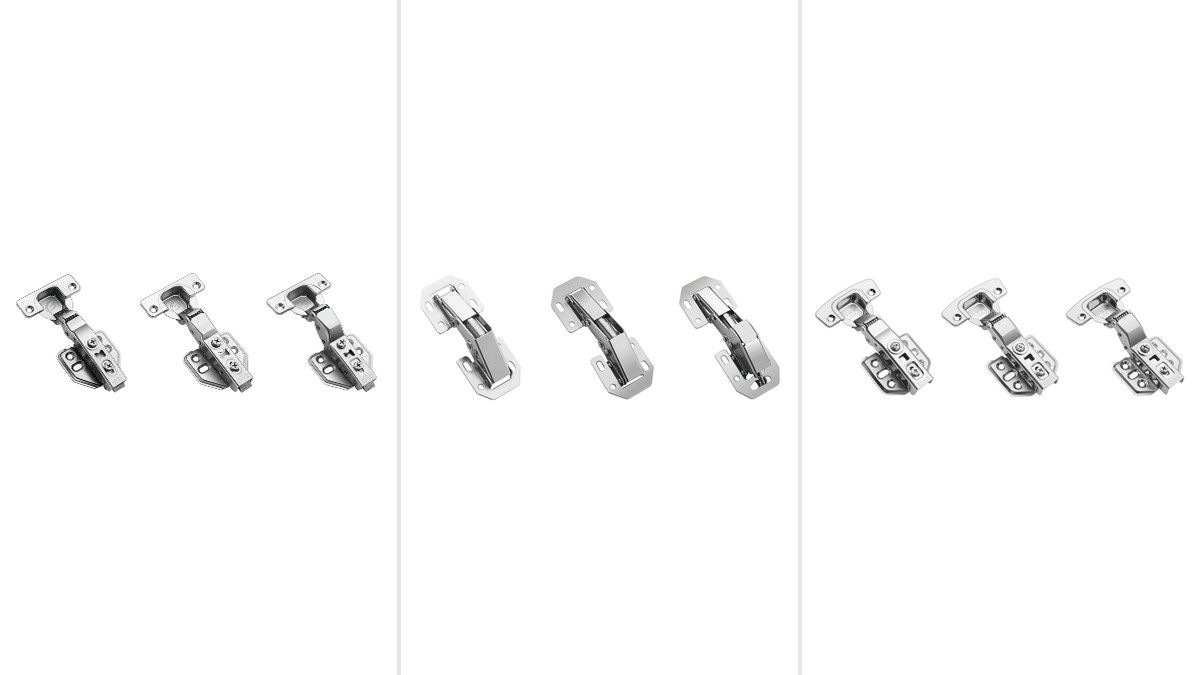
Furniture hinges? They look simple, you see them every day and they are used extensively at every home. But looking at them closely one can realize they are not actually that simple. Especially the ones with damping function. Yet, they are very very cheap and produced at massive scale by various manufacturers in China. True magic of manufacturing with scale.
Most of what construction and furniture factories use today is the European-style concealed cup hinge. The door hides the hardware when closed. Factories in Guangdong hardware clusters stamp these out at high volume, nickel-plate or polish them, and ship FOB from ports like Shenzhen. The category is cheap on a per-piece basis, but it is not a simple sourcing process since there are many types and sizes.
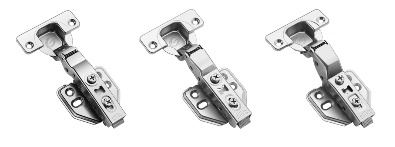
What the Line Looks Like
A typical hinge factory catalogue covers soft-close buffer hinges, standard spring hinges, stainless versions, special-angle corner hinges, and surface-mount "frog" styles. Cup diameter is almost always 35 mm. Door thickness on the mainstream wooden-board range sits around 14–20 mm. Opening angle on the common soft-close cup hinges is usually about 105°.
Easiest way to know if the quality is high or not is weight. Lighter ones are around 70–80 g. Mid tier models usually 100 g+. And there are also stainless waterproof models which are the heaviest at 110–120 g. And based on the logic I laid out the stainless steel ones are truly high quality and best suited to use in bathrooms and kitchens because those rooms are most prone to humidity and water. Steel thickness on the stamped parts commonly runs 1.0–1.2 mm. Surface options you will see often are bright nickel, polished stainless, and darker finishes such as gun black for visible or design-led interiors.
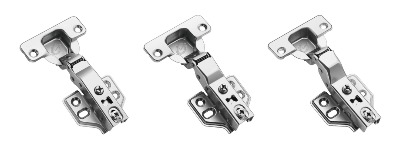
The Main Types You Will Order
These are generic items so no need for marketing mumbo-jumbo here. These are the main models you will need and popular in most of construction projects:
- Full overlay (straight arm): door fully covers the cabinet side panel edge. This is the default for most kitchen and wardrobe runs.
- Half overlay (cranked arm): two doors share one partition. Each door covers half the panel edge.
- Inset / insert (deep crank): door sits inside the carcass, flush with the frame look.
- Soft-close (buffer / hydraulic): damper slows the last part of the close. This is what most modern projects ask for.
- Frog / surface-mount: no 35 mm cup boring in the door. Faster install on some production lines, different look, different price.
- Special angle (45° / 90° corner): corner and blind-corner cabinets. Smaller share of volume, but you need them when the kitchen plan has corners.
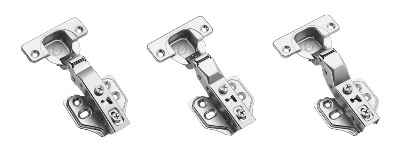
If you mix full and half overlay by mistake on a partition wall, installers feel it immediately. So make sure exactly what you need before you place the order. The manufacturers produce 100s of models (there are also non-standard models for custom made projects) and they can't know what you need from the pictures alone. We can help you with that if you need help by the way.
Models That Show Up on Bulk Orders
Factories use their own model codes. The ones we keep seeing on competitive iron and stainless quotes look like this:
- G7-class (~72 g iron): light volume hinge, nickel look, full and half overlay. Entry band for large housing packages.
- G8-class (~80 g iron): a step up in arm mass. Still a high-volume construction SKU.
- G95-class (~100 g+ iron): heavier soft-close cup hinge. Often the workhorse when the buyer wants a stronger feel without jumping to stainless.
- SS / waterproof stainless: stamped or marked as stainless (often 304 on the cup). Better choice for kitchens, bathrooms, and humid sites.
- Frog hinge: surface-mount multi-pivot style for lines that skip cup drilling.
- Gun-black finish: same mechanical family with a dark coating for darker interiors or visible hardware moments.
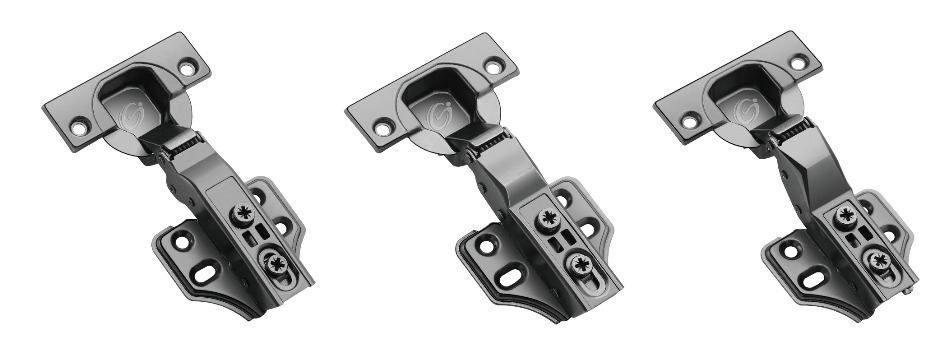
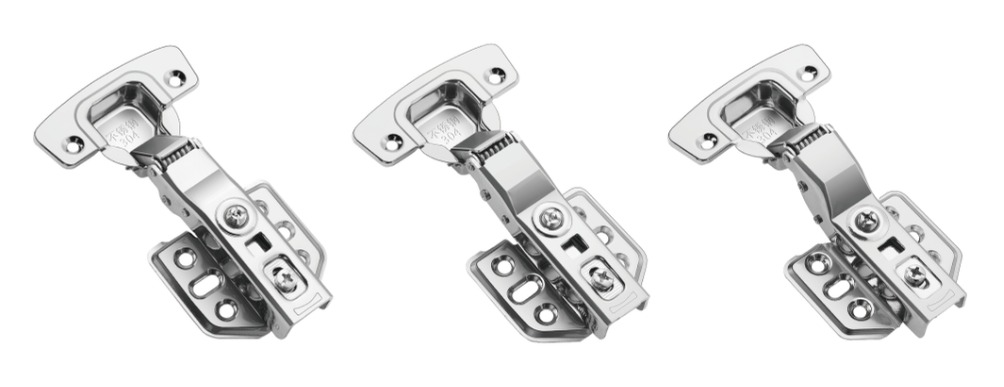
For a construction bulk program I would not buy every catalogue page. Start with full and half overlay in one iron soft-close grade, add stainless for wet zones, and only then add frog or special-angle SKUs if the joinery plan needs them.
Specs That Matter for Buyers
As I mentioned before the order, you need to make sure that you lock these specs to minimize the product mismatch:
- Overlay type: full, half, or inset. No vague "standard hinge" wording.
- Cup size: confirm 35 mm and cup depth match your boring machine setup.
- Door thickness range: usually 14–20 mm on wooden boards; confirm if you run thicker panels.
- Opening angle: common soft-close cup hinges around 105°; corner hinges are different.
- Material: cold-rolled iron vs stainless. Ask for the grade mark on stainless cups if that is part of the claim.
- Unit weight: weigh samples. A "102 g" model that lands at 85 g is a different product.
- Steel thickness: 1.0 mm vs 1.2 mm vs thicker stainless builds change door feel and fatigue life.
- Soft-close behavior: cycle samples. Listen for noise, check that the damper still works after repeated closes.
- Mounting style: fixed screw-on vs clip-on plate. Clip-on helps service and factory assembly speed.
- Screws and bags: not all manufacturers will include screws. Make sure you ask if they do or not.
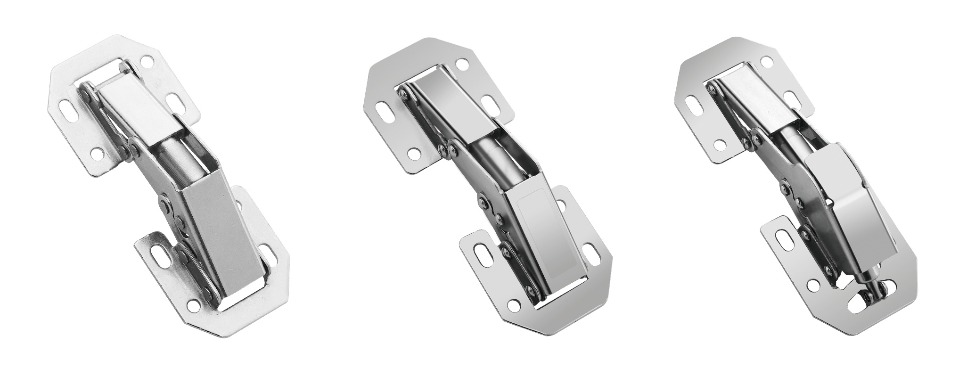
I always ask for a small mixed sample set of each overlay before bulk. Hang them on scrap doors with the same board thickness as the project. Gap, sag, and damper feel tell you more than a catalogue photo.
I have a giant bag of samples as I am writing this blog in front of me. And trust me when I say this, they look almost identical but they certainly are not. So make sure you understand your specs above before asking me to source you "standard hinges". Standard is different for each project.
Packaging and Carton Math
These are dense, low-volume freight items compared with bulky decor goods. That helps construction buyers.
Typical packing pattern on iron soft-close cup hinges:
- About 200 pieces per carton on common models
- Mixed full and half overlay packed by model line
- Screws often added into colored bags when the buyer requests it
- A mid-size bulk lot in the about 10,000 piece range can sit near 50+ cartons, roughly 1 tonne gross, and under 2 CBM
Because hinges are heavy for their size, weight often matters as much as volume on sea freight. Ask for carton outer size, pieces per carton, net/gross weight, and whether screws are included before you compare two factories on unit price alone.
Lead time on a normal production slot after deposit is often around one month, give or take factory load. Quantity tolerance around a couple of percent is common on this kind of hardware PO. But some large manufacturers, especially the ones we are working with have large stock of best selling models. So depending on your order size you might not have to wait at all.
Price Band (FOB China)
Hinge pricing is one of the clearest "mass production wins" in furniture hardware. On current iron and stainless soft-close cup lines of this type, FOB China unit prices typically sit under about 2 RMB, with light iron volume SKUs toward the low end of that band and stainless or frog styles higher inside it. In rough USD terms for planning, that is usually about US$0.10–0.20 per piece FOB, before special packing, custom finishes, and inspection.
What moves the price most:
- Unit weight and steel thickness
- Iron nickel vs stainless
- Soft-close damper quality
- Dark or special finishes
- Screws and retail-style bag packing
- Order volume and mixed-SKU complexity
Always quote landed cost with freight, duty, and screw kits. A hinge that is a few cents cheaper but needs separate screw sourcing is not cheaper on site.
Who This Product Is For
This category fits:
- Construction companies and fit-out contractors buying cabinetry hardware in bulk
- Kitchen and wardrobe manufacturers that need stable full/half overlay supply
- Project buyers who want one factory to cover iron volume SKUs plus stainless wet-area SKUs
- Importers building a basic hinge assortment around a short list of grades
It is a weaker fit if you need branded European architectural hardware with published cycle-test certificates as the main selling story. Those programs exist, but they sit in a different price and documentation band than high-volume construction hinges.
How We Source Lines Like This
At Pyxis we work from China with hinge factories that actually stamp and plate these parts. For a construction bulk program we typically:
- Shortlist factories on overlay range, stainless options, and packing discipline
- Lock a small SKU list (not the whole catalogue)
- Pull comparative FOB quotes on weight-matched samples
- Cycle-test soft-close samples on the real board thickness
- Confirm carton counts, screw packing, and marking before production
If you already know your channel, first quantity, and must-have overlay mix, send that over. We can come back with a shortlist, a sample plan, and current FOB ranges for the grades that fit the project.
I tried my best to explain these products to you in this blog. But, if you are a busy person and don't want to deal with the headache of confirming and locking every detail I mentioned here then contact us and we will handle it for you.

