


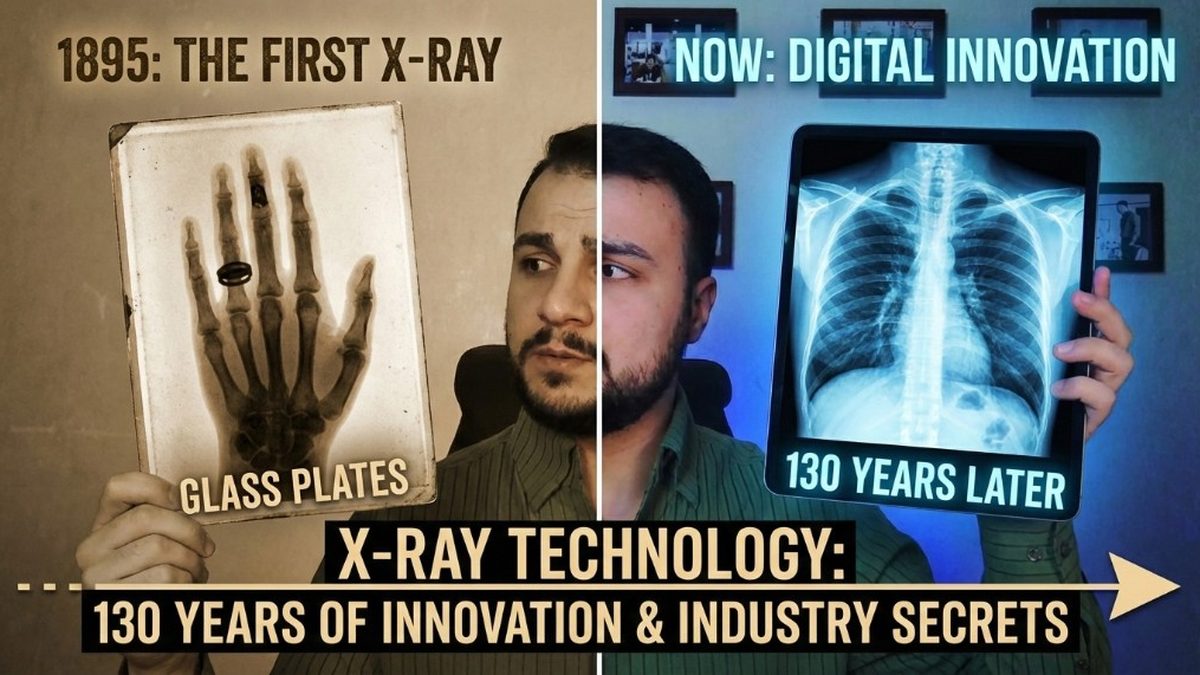
It has been about 130 years since we first became able to see inside the human body without surgery. Great technologies almost always begin with great risks, and X-ray imaging was no exception. This is the story of how X-ray printing went from fragile glass plates and hazardous chemistry to the safe, fast, chemical-free technology used in clinics today. For buyers comparing suppliers, it also explains what that history means when sourcing dry film printers and related hardware from China.
Dry film printers at a glance
| Check before you buy | Why it decides the deal |
|---|---|
| Film sizes and drawers the clinic uses | The printer has to match the films they already run |
| Throughput class | Roughly 80 vs 160 films per hour |
| Film chip and ongoing film cost | Printer price alone hides the consumable |
| Brand-name vs China-built supply | Film, spares, and service have to keep coming |
| Install, spares, and electrical compliance | A printer that cannot be serviced locally sits idle |
Before you source dry film printers from China
- Film sizes and drawers your clinic actually uses
- Throughput need: roughly 80 vs 160 films per hour class
- Film chip compatibility and ongoing film cost, not printer price alone
- Brand-name vs China-built printer and film supply chain
- Installation, spare parts, and local service support
- Import documents and electrical compliance for your country
Roentgen's Discovery
Wilhelm Roentgen discovered X-rays in 1895 in Germany while experimenting with cathode ray tubes powered by high-voltage electricity. On the evening of November 8, he was testing whether cathode rays could pass through various materials, and he had covered the tube with thick black cardboard to block its visible glow.
In the darkened room, he noticed a faint greenish glow on a small screen coated with barium platinocyanide, a fluorescent material sitting on his workbench. This was surprising: the screen was one to two meters away, and the tube was fully covered, so no ordinary light could have escaped. He realized some new, invisible rays were penetrating the cardboard and exciting the screen.
Roentgen spent the next seven weeks investigating the phenomenon alone in his lab, barely sleeping, documenting everything. The rays passed through paper, wood, cloth, and thin metal, but denser materials blocked them. On December 22, 1895, he placed a photographic plate behind his wife Anna Bertha's hand for a 15-minute exposure. The image showed her bones clearly, along with two rings on her fingers: the first medical X-ray image in history. He named them X-rays because they were unknown, and the discovery earned him the first Nobel Prize in Physics in 1901.
From Glass to Flexible Film
Glass plates were the standard for recording light at the time, so early X-ray images were captured on glass coated with a light-sensitive emulsion of silver halide crystals suspended in gelatin. X-rays striking the crystals changed their state, forming the image. Siemens made the first X-ray tubes and devices, while Kodak supplied the glass plates.
But glass plates were fragile, heavy, and costly, and handling them was a daily challenge for healthcare professionals. The fix came from the photography industry. In 1918, George Eastman, the founder of Kodak, introduced improved X-ray film: a flexible, transparent material that could be coated with photographic emulsion. It solved the problems of fragility, weight, and cost. One major flaw, however, remained: toxic chemical processing.
The Wet Chemistry Problem
Exposing the film was only half the job. After exposure, films went through a five-step development procedure that was slow, complex, and dangerous.
- Development: a chemical bath containing hydroquinone and metol for rapid image emergence, plus alkali to keep the pH high, with temperature precisely controlled or image quality suffered.
- Stop bath: to prevent the fixer from being neutralized too quickly.
- Fixing: a solution of sodium or ammonium thiosulfate, with hardeners like potassium alum and acids like sulfuric acid, removed unexposed silver halide crystals and hardened the emulsion.
- Washing: essential so the film could be handled safely; done poorly, the film deteriorated over time.
- Drying: before the film could be used.
Most of these chemicals were toxic, and health professionals suffered for years as a result. The darkroom-based, multi-step process was not just inefficient, it was hazardous for the very people running it.
The Dry Film Revolution
The breakthrough arrived in the mid-1980s, when Fujifilm developed the DryPix system. It used special thermally sensitive film, and heat from a thermal print head created the image directly. No darkrooms, no chemicals.
GE Healthcare, Siemens, Canon, Agfa, and Carestream followed, and from the early 2000s dry film rapidly replaced wet processing. Ironically, Kodak, which had led two of the previous evolutions of X-ray film, was slow to adapt. The company struggled through the early 2000s, and in 2007 its healthcare division became Carestream Health.
The Market Today
The X-ray film market is declining as digital imaging spreads, but it is still valued at around $1 billion in 2024 to 2025, and the shrinkage has plateaued. Fujifilm, Agfa, and Konica together hold about 60% of the market, with the rest divided among players like Carestream and Sony.
Popular printers include the Fuji DryPix Smart, a compact tabletop unit producing up to 80 films per hour, and the DryPix Plus, which outputs 160 films per hour and takes three drawers for different film sizes. Agfa competes closely with models like the Drystar 5302 and the AXYS, the former offering higher density for mammography and general radiology. On the film side, Fujifilm's main types are DI-HT and DI-HL, while Agfa offers DT2B for general use and DT5B as a premium, thicker version.
There is a catch, and it will sound familiar. Just as inkjet printers use chips to lock users into expensive cartridges, X-ray films carry chips too. But unlike consumer printers, the printers themselves are not cheap: they cost between $10,000 and $40,000. Chinese manufacturers have stepped in by copying or licensing these chips to offer cheaper films, and their printers deliver near-identical quality at lower cost, filling gaps in developing markets.
Why Film Isn't Going Away
I believe that no matter how far digitization goes, demand for physical printed X-ray film will persist, just as it has for paper printing. The industry has matured by completely eliminating the toxic and environmentally damaging procedures from the imaging chain, and new Chinese manufacturers are making this technology accessible to markets that could never afford the established brands.
At Pyxis Product Sourcing, we play a small role in that process by connecting international hospitals and medical equipment distributors to Chinese manufacturers. If you need medical products, X-ray printers, or films, contact us and tell us what you need.
Conclusion
Buy the printer and the film path together. Chip lock-in and the cost of film matter more than the sticker price, and the unit still has to match the drawers, the hourly volume, and the electrical rules in the country where it will run.
Next Steps
If you are evaluating dry film printers or related medical imaging hardware from China, request a sourcing review, see product sourcing, or check pricing. For another technical sourcing case, read discontinued ABB switchgear parts.